
Home support is help at home with washing, dressing, meals and medicines. In BC around 35% of seniors receiving home support pay part of the cost, based on their after tax income. It is the home version of the 70% to 80% of income people pay in assisted living and long-term care.
Right now the home care fee rule hits lower-income seniors very hard, taking up to 36% of their after-tax income. That has to change. BC also has a $300 cap rule that lets seniors with earned income pay no more than $300 a month. Low-income seniors need relief, but this rule has been easily abused for decades with a little creative accounting and should be removed.
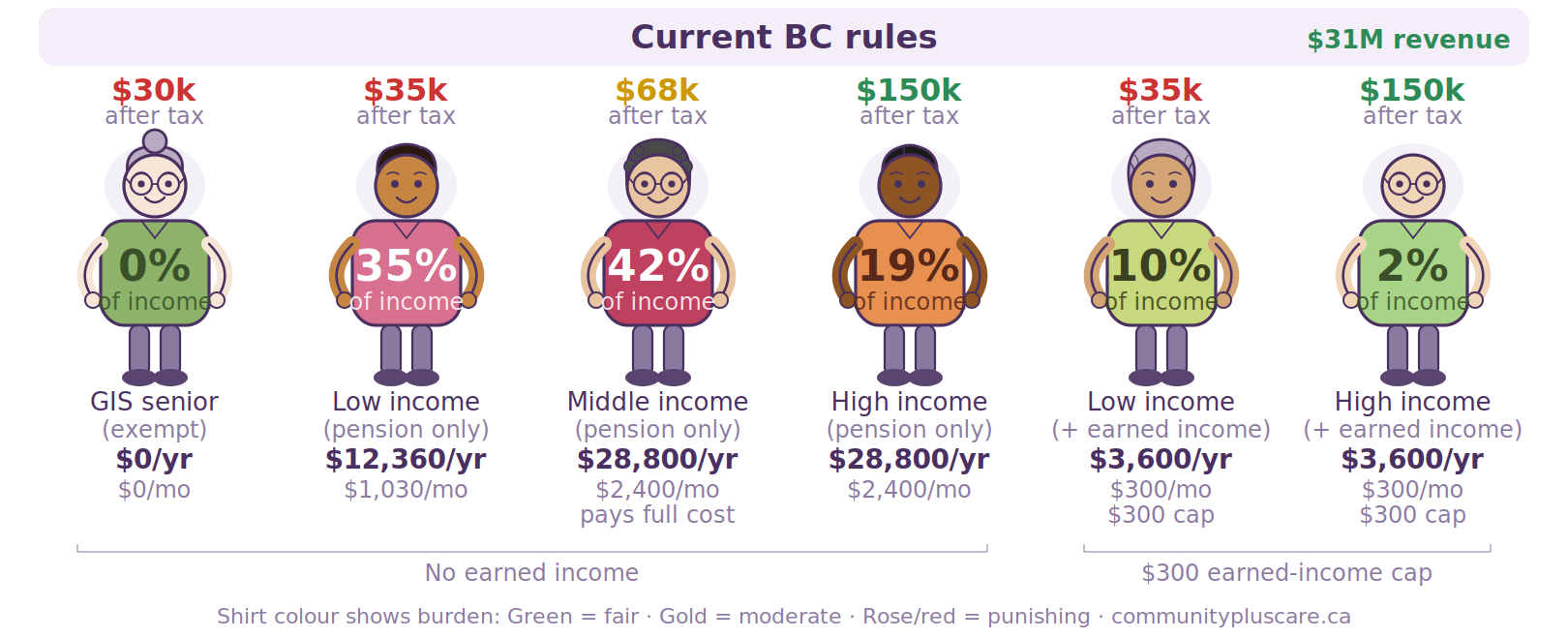
How the rule works today
Your daily rate is a ceiling, not a flat charge: the cap only matters once a day's care costs more than your rate.
- A single senior with $33,000 after tax pays about $960 a month for one hour of care a day. That is a third of everything they have.
- A senior with $45,000 after tax pays about $1,213 a month for one hour a day. So does a senior with $150,000. The rule stops rising once it reaches what the care actually costs, about $40 an hour.
- If you or your spouse has any earned income, even $500, your bill is capped at $300 a month. A wealthy retiree with a little consulting work can pay less than a low-income pensioner with no earned income.
- The $10,284 deduction has not changed since 1997. Back then it was about 60% of what a typical senior earned. Now it is about 30%.
You can check your own rate with our Government Care Cost Calculator, or in the model further down this page.
What the evidence shows
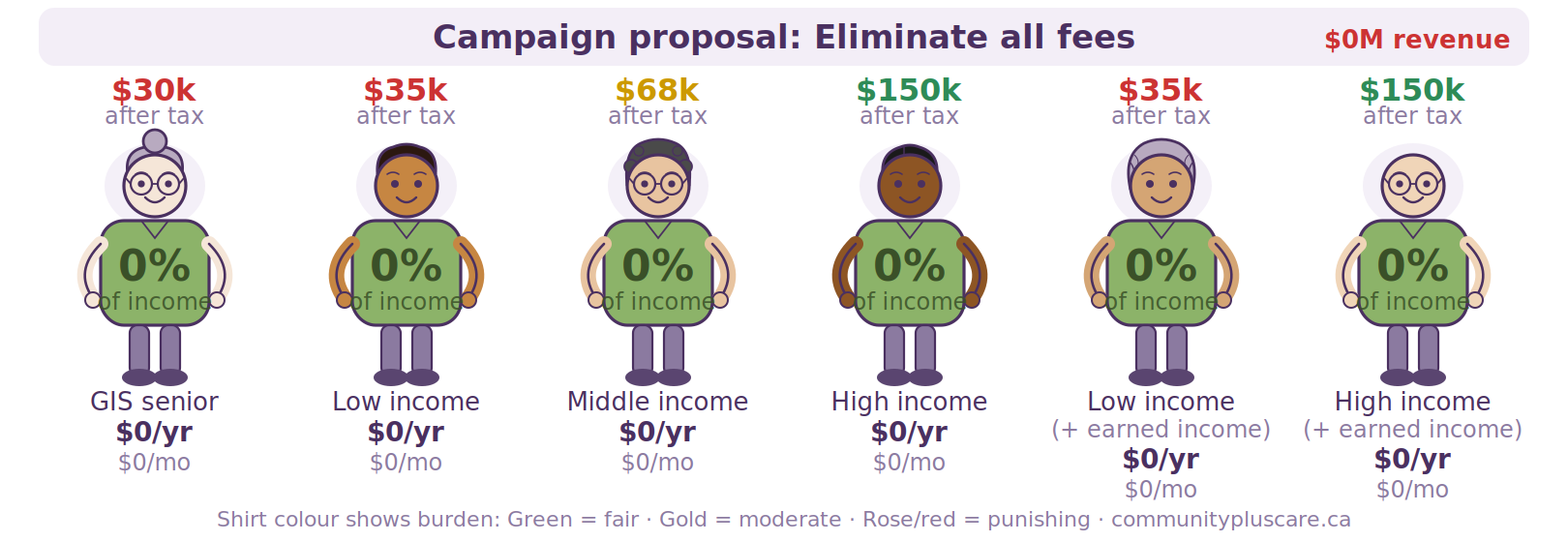
The Health Care Needs Home Care campaign, which wants home support made free for every senior, says fees push seniors into care homes early. No study or dataset shows that. Fees do need reform, to protect low-income seniors, but high-income seniors should keep paying.
The Canadian Institute for Health Information (CIHI) found that about 1 in 9 people admitted to long-term care across Canada in 2018-19, and 1 in 7 in BC, had a health profile that could have been managed at home. When CIHI asked people about barriers to care (they only asked 30 people), they brought up four challenges:
- Not knowing how to get services
- Out-of-pocket costs for care that public home care did not cover (This is about paying privately for added care, NOT about home care fees)
- Unreliable and inflexible workers
- Missing social and cultural supports
No published data supports the claim that care fees push seniors into care homes faster. The BC Ministry of Health already holds the admission records, the fee each person was assessed, the hours they were offered and whether they turned service down. If fees were pushing people into care homes early, the proof is in that data.
The campaign points to Alberta and Ontario, where home care carries no fee. Neither is a picture of free care that people can count on. Ontario's Auditor General found clients put on waiting lists for personal support, people with the same assessed needs getting five, eight or ten hours a week depending on where they lived, hours well below what the regulation allows, and agencies rationing by time of year. Alberta has cut home care hours to stretch its budget across a growing list, and hour caps there still leave people skipping meals and showers. Take away the price and the rationing moves to the waitlist and the hour cap.
The campaign's headline statistic, that 61% of people entering long-term care had no home support in the 90 days before, does not mention fees. Most of those people would have paid nothing. The question is why they were not getting care, and our experience says the answer is care they could not count on.
The bigger barrier, in our experience, is care people cannot count on. More on that below.
Our plan: a sliding scale
We would keep the fee and fix the scale:
- Pay nothing if your income after tax is under about $33,000. That is the GIS line (about $30,000, where the Guaranteed Income Supplement stops) plus 10%, so it moves every year on its own.
- Pay the full cost of each hour if your income is above $75,000.
- Pay a share in between. The share climbs in a straight line and reaches 100% at $62,139, the income where BC already charges the most for a care-home bed, so it moves every year too. A yearly cap, 25% of the income above the floor, softens the top of the climb, which is why the full cost only lands at $75,000.
- Reasonable for everyone. Care fees take 1% to 7% of income for seniors between $33,000 and $45,000. Nobody pays more at home than a care-home bed would cost them.
- Close the earned-income loophole. The $300 cap goes. Working households are still protected, because the first $25,000 of each person's earned income is ignored.
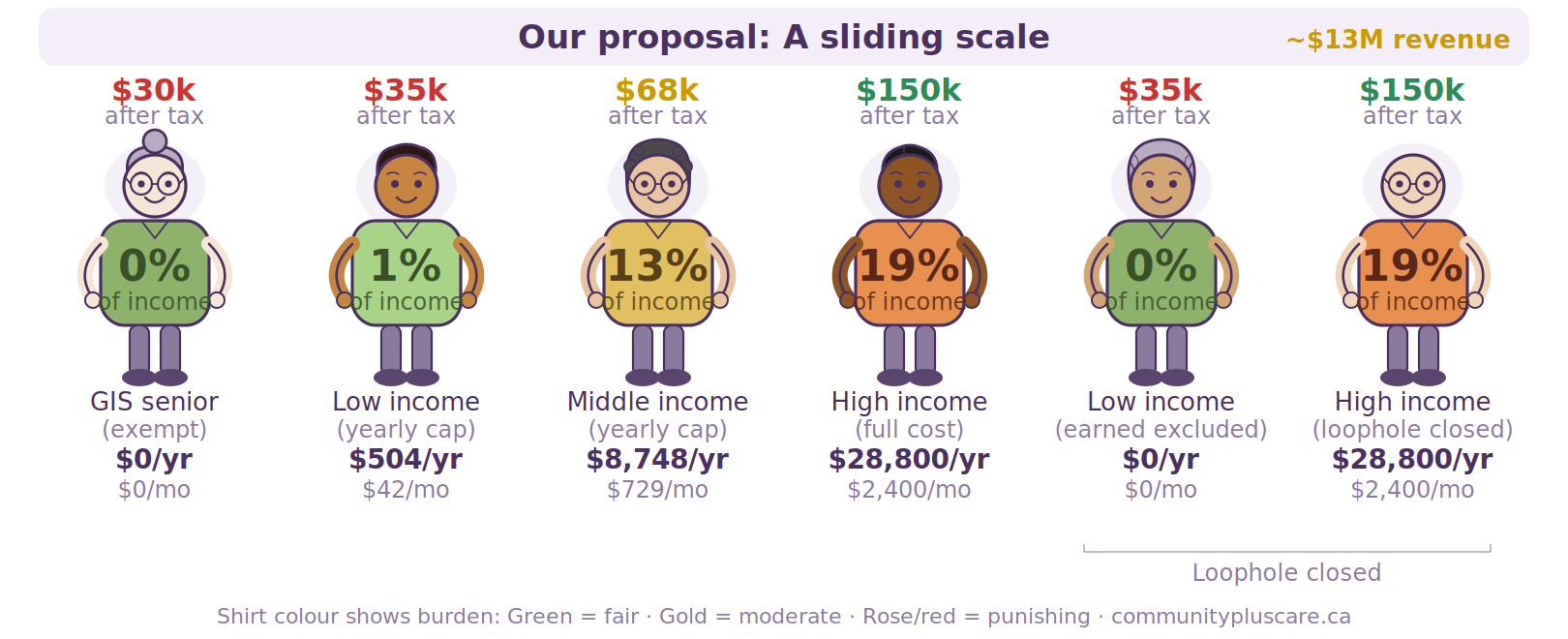
Under our plan a $33,000 senior pays nothing instead of about $960. A $36,000 senior pays about $62 a month instead of about $1,080. A $45,000 senior pays about $250 instead of $1,213. A $75,000 senior pays what they pay today. The $150,000 retiree with $500 of consulting income pays $1,213 instead of $300.
Try any income, household and care pattern in the model below.
A bigger problem than the fee: Care you can count on
Money is not the main reason seniors give up on home support. In our experience it is the stream of different faces. Visits come at different times from different workers, and each new person has to be shown the same things again. Many seniors, especially those with dementia, will not let a stranger help them bathe. So they cancel the visit, or refuse the service, and the help stops. That is when the falls, missed medicines, poor eating and hospital visits start, and a care-home bed becomes the only option left.
The evidence backs this up:
Cutting the fee does nothing about any of this. We would put the effort into making public home support reliable and consistent: the same small team, at the same times, with enough hours to matter. That would keep more seniors at home than free care they cannot count on.
What should change instead
Three changes would do more for seniors than dropping the fee:
- Continuity standards. Set and follow continuity-of-care standards. Ours are built on the practical minimums needed to keep a care team stable, and the government's should not be far from them: Continuity of Care Standards.
- Time-change and communication standards. Currently government gives a four-hour window that care may occur within. The policy does not reflect how home care actually operates. In most situations we are aiming for a given time and shifting a visit by up to an hour when something goes wrong or to protect continuity. Shortages in government caregiver supply do force greater time changes than an hour, and every such change should be phoned through to the client, not just changed in the schedule: Visit Timing vs Team Continuity.
- Put high-risk seniors who refuse care first. It is very common for high-risk seniors to refuse care. They may have dementia or cognitive decline but have not been found incapable of making their own care decisions, so a refusal is respected. If they do accept care and then get different people coming each day they will almost certainly refuse the support going forward and become a higher risk for falls, infections and hospitalization. Currently, "difficult" seniors who are resistant or aggressive when different people come to their home each day are treated like the problem. This is not a person-centred perspective and we are not providing person-centred support for these high-risk individuals. High-risk seniors who are resistant to care need to be prioritized and given a meaningful opportunity to accept support that doesn't victimize and blame them: Resistance to Care.
Send this to your MLA
If you want home support fees fixed rather than scrapped, and care you can count on, send your MLA this page. Find your MLA by postal code, then paste the link to this article into a short note saying what matters to you.
Find your MLA ›What the government collects
Fees bring in about $31 million a year. Our plan keeps about $13 million of that; the campaign plan keeps none.
Show the numbers
Fees bring in about $31 million a year today, out of $693 million spent on home support. Under the campaign plan that drops to zero. Under our plan it drops to about $13 million, and almost all of the difference is relief for people earning under $62,000. People above $75,000 pay the same as today, and closing the $300 earned-income loophole takes away the incentive for creative accounting. Each senior kept out of a care home saves the province about $45,800 a year, so about 400 avoided admissions would cover the whole change.
Sources
- BC Reg 330/97, Continuing Care Fees Regulation
- Home and Community Care Policy Manual, Chapter 7 (client rates, effective January 1, 2026)
- Office of the Seniors Advocate, We Must Do Better: Home Support Services for B.C. Seniors (2023)
- Office of the Seniors Advocate, BC Seniors: Falling Further Behind (2022)
- Office of the Seniors Advocate, Home Support Survey of 17,500 clients (2015-16), and Every Voice Counts: Long-Term Care Resident and Visitor Survey (2023)
- Canadian Institute for Health Information, Common Challenges, Shared Priorities, Volume 2 (2020): the 1-in-9 indicator and the focus-group barriers
- Russell D. et al., Continuity in home health care: is consistency in nursing personnel associated with better patient outcomes? Journal for Healthcare Quality (2011)
- Reckrey J. et al., Home care worker continuity in home-based long-term care, Innovation in Aging (2024)
- Huang J. et al., The consequences of unmet needs for assistance with daily life activities among older adults: a systematic review (2024); and Unmet needs and healthcare service utilization among older adults: a systematic review (2024)
- Auditor General of Ontario, 2015 Annual Report, section 3.01, CCACs: Home Care Program, as summarized by the Standing Committee on Public Accounts; see also The Globe and Mail, 2 December 2015
- Calgary Herald, 18 December 2012, Home care hours cut 15 minutes by province; Friends of Medicare, Home Care
- Island Health, Home and community care rates: "you will never pay more than the actual cost of service"